 since 2012
By the numbers: if you had invested $1,000
5 years ago
$970
from Oct 2021 · -0.6% a year on average
Entire listed history
$26 500
from Apr 2017 · +41% a year on average
Deepest drawdown
-99%
from the Jul 2021 peak to Dec 2022
Now vs. peak
-30%
Dec 2025
Price history — log scale: equal height means equal percentage change
Numbers on the chart match events in the timeline.
Based on monthly closes with dividends reinvested (source: Yahoo Finance, CVNA). Past performance does not guarantee future results.
Two dates, one stock
Put two dates side by side.
December 27, 2022. Carvana stock closed at about $3.70. That is four times cheaper than its 2017 IPO price of $15. Analysts are openly writing about bankruptcy; its bonds trade below 50 cents on the dollar.
January 22, 2026. The same stock (adjusted for the 5-for-1 split of May 2026) has gone from $0.74 to $95.69. That is roughly 130 times, in a little over three years. $1,000 invested at that low would have been worth more than $120,000 at the peak.
All prices on this page are approximate, calculated from Yahoo Finance split-adjusted monthly and daily data.
But reading this story as "see, you just have to buy at the bottom" is the most dangerous way to read it. Most companies that fall 99% never come back. Carvana is the exception. To understand why it was the exception, let's start at the beginning.
A "vending machine" for cars
Carvana was founded in 2012 in Arizona. One of its founders is Ernest Garcia III. His father, Ernest Garcia II, owns DriveTime, a used-car dealer and lender. Carvana's initial funding came from DriveTime.
The idea was simple: buying a used car is a process most people hate. Haggling, hours in a showroom, distrust. Carvana moved the whole thing online: you pick a car on the website, arrange financing online, and the car is delivered to your door — or you "collect" it from a glass tower.
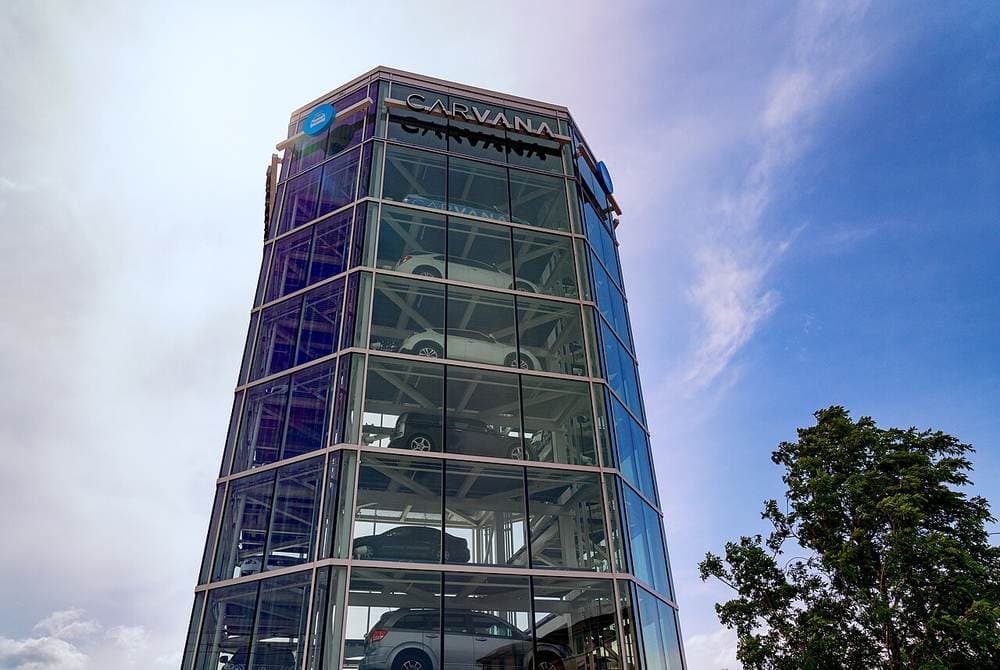
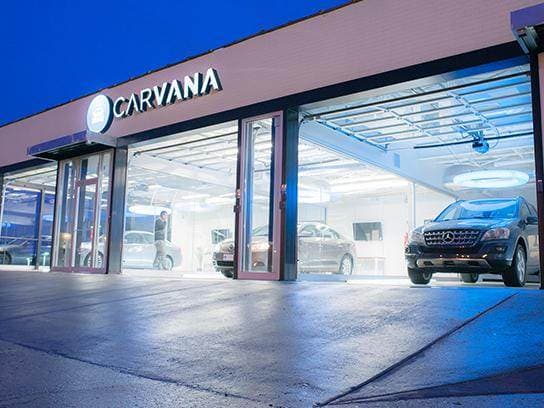
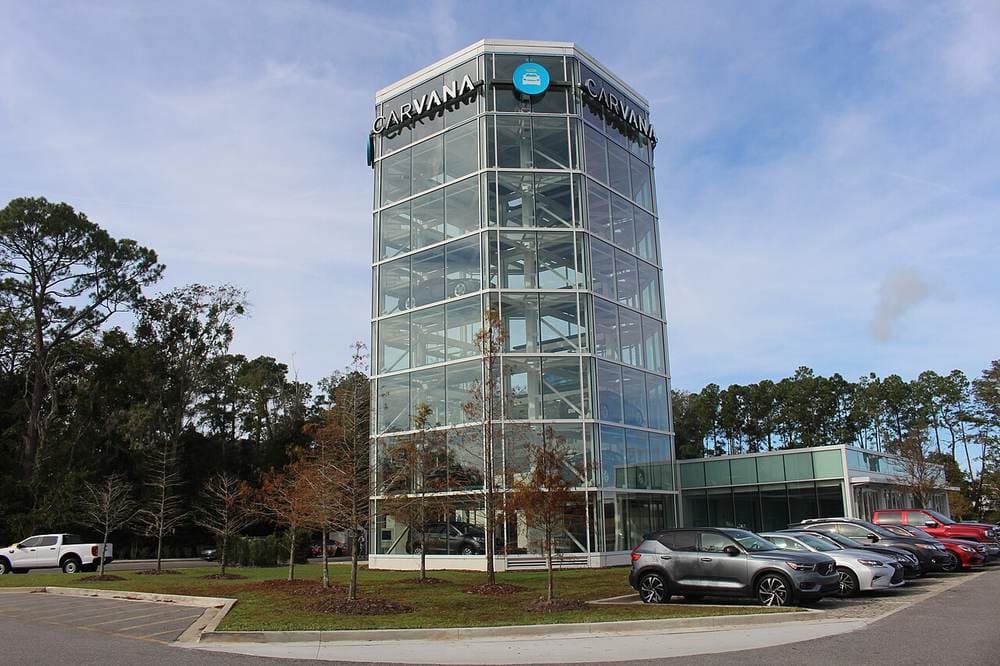
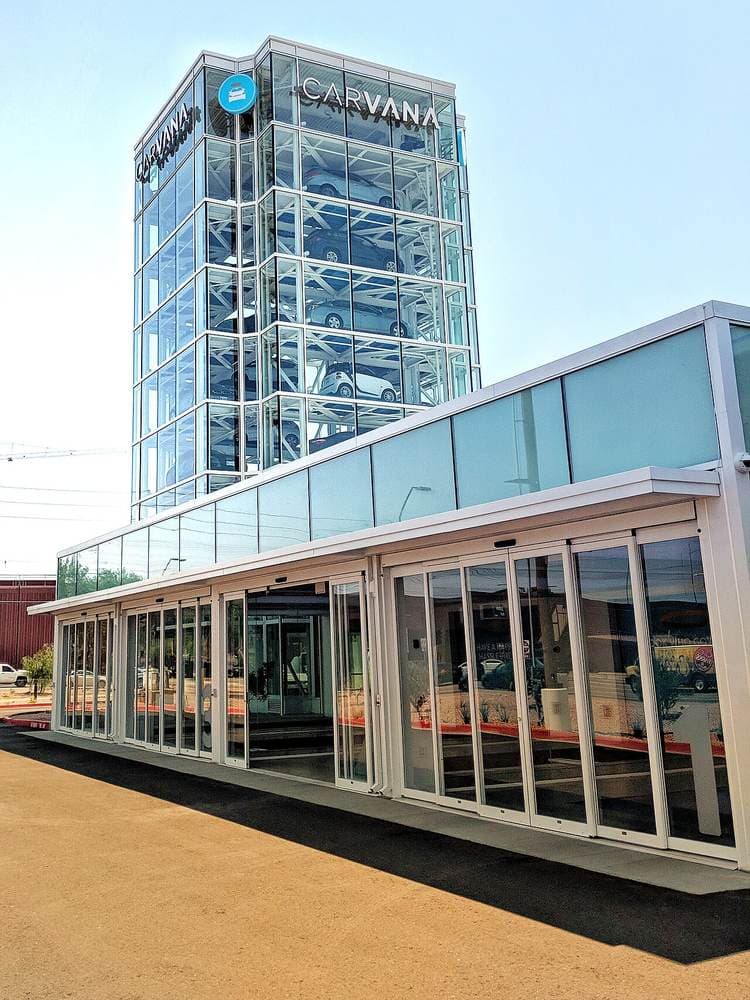
These towers became Carvana's best-known symbol. Cars are stacked inside a multi-storey glass building; the buyer drops in a special coin and a mechanism brings the car down. The first vending machine opened about a year after the company was founded, and a fully automated, coin-operated version appeared in Nashville in 2015.
It was marketing — but very powerful marketing. In April 2017 the company listed on the New York Stock Exchange at $15. The stock fell on its first day. Nobody knew what the next four years would bring.
The pandemic: when everything seemed to go right
Then came 2020. People were stuck at home, showrooms closed, buying online became normal. Demand and prices for used cars jumped. For Carvana it was a perfect storm.
In 2020 the company sold more than 244,000 cars, and revenue reached $5.6 billion. In 2021 sales rose to 425,000 units and revenue to $12.8 billion. The stock soared too: on August 10, 2021 it closed at $370.10 — a record (about $74 split-adjusted).
Management pressed even harder on growth. New inspection centers, new towers, new hires. In early 2022 Carvana announced the purchase of ADESA, the second-largest U.S. wholesale auto auction chain, for $2.2 billion. The deal was financed largely with debt.
Garcia III later summed up the situation in one sentence:
"We made a big bet on our future and financed it with debt." (CNBC)
When the bet is made with debt, there is no room for mistakes. And 2022 turned out to be a year of mistakes.
2022: "the equity could be left worthless"
The pandemic ended, and the Federal Reserve raised interest rates fast. Car loans got expensive and used-car prices started to fall. Carvana was left with cars bought at high prices, huge expenses and billions of dollars of debt.
The sequence was brutal:
- May 2022. According to the Wall Street Journal, the company cut about 12% of its staff — roughly 2,500 people.
- November 2022. Third-quarter results were weak, sales fell 8%, and the stock dropped about 40% in a day.
- December 7, 2022. Bloomberg reported that the largest creditors — Apollo and Pimco — had joined forces for restructuring talks. A Wedbush analyst cut his price target to $1, warning that a restructuring in bankruptcy "could leave the equity worthless." The stock plunged by a record of up to 45% in a single day. The company's 2030 bonds traded at about 42 cents on the dollar.
By Fortune's count, the stock was then nearly 99% below its peak, with about $60 billion of market value erased. At year-end Carvana reported a $2.9 billion net loss for 2022 — about $21 lost for every $100 of revenue.
To the market the verdict was clear: next bankruptcy. But no bankruptcy came.
How it survived
What saved Carvana was not one magic step, but a combination of three things.
First — costs. According to CNBC, the company spent about 18 months rebuilding itself: headcount fell by more than 4,000 and about $1.1 billion was removed from annual expenses. The goal was no longer "growth at any price", but profit on every car sold.
Second — debt. In July 2023 Carvana announced a deal with bondholders led by Apollo. Holders of more than 90% of its unsecured notes agreed to swap their old paper for new notes. As a result total debt fell by more than $1.2 billion, most of the 2025 and 2027 maturities were pushed out, and required cash interest over the next two years dropped by more than $430 million a year. In return, creditors received new debt secured by company assets.
Third — time and luck. Garcia III doesn't hide it: in his words the company "caught some breaks" and "you've got to get a little lucky along the way." Another line: "In those moments, I think, the biggest risk is if people decide to give up." (CNBC)
The stock jumped sharply on the day the deal was announced. By the summer of 2023 it was already more than ten times above its low — but the biggest run was still ahead.
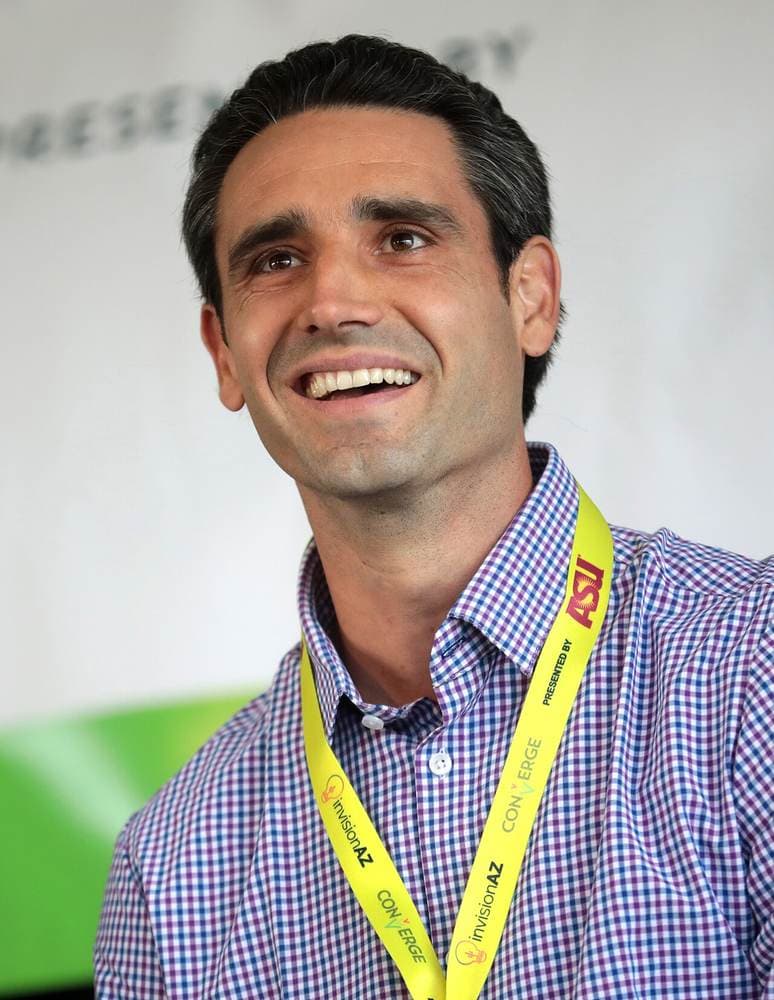
The comeback: from losses to record profit
The numbers changed step by step. In 2024 Carvana sold 416,000 cars and reported $404 million in net income — two years after a $2.9 billion loss. And 2025 was a record year:
- cars sold — 596,641 (+43%);
- revenue — $20.3 billion, above $20 billion for the first time (+49%);
- net income — $1.9 billion (about $621 million of it a non-cash, one-off accounting benefit).
The market answered in its own language. On December 22, 2025 Carvana joined the S&P 500 — a company expected to go bankrupt three years earlier entered the list of America's 500 largest companies. On January 22, 2026 the stock closed at $95.69 split-adjusted — about 130 times its December 2022 low, and well above its 2021 peak.
In March 2026 the company announced the first stock split in its history: from May 7, every share became five. So if you see prices like $370 or $3.55 in older articles, they look five times smaller on today's chart.
But a stock that has risen never sits still. And the comeback itself did not come without questions.
Doubts and open questions
In early January 2025 short seller Hindenburg Research published a harsh report on Carvana and disclosed a short position. These are allegations, not a court or regulatory finding. Hindenburg claimed:
- the turnaround is a "mirage" built on accounting choices and loose underwriting;
- about $800 million of auto loans in 2024 may have been sold to an undisclosed related party;
- 60-day loan delinquencies are several times the industry norm;
- Ernest Garcia II sold more than $3.6 billion of stock in 2020–2021, and another $1.4 billion after the 2023 rally.
Carvana called the report "intentionally misleading and inaccurate", noting that the same arguments had been made before by other short sellers who want to profit from a falling stock. The stock fell at first, then kept rising. Separately, a shareholder class action against the company in federal court in Arizona was still ongoing as of early 2025.
One more truth: even after a 130x run the stock did not rise in a straight line. From its January 2026 peak it fell more than 40% by the end of March. A stock that multiplies also swings by multiples.
What this story teaches
- 1
Buying a stock that fell 99% usually doesn't work
- 2
Growth bet with debt is a double-edged sword
In the pandemic boom debt made Carvana big fast; when the boom ended it nearly killed the company. When you analyze a company, look not only at revenue growth but also at the size of its debt and when it comes due.
- 3
Getting a multibagger is possible, holding one is hard
To see 130x from the low, you had to buy in December 2022 amid bankruptcy headlines, and then not sell through -40% swings. Very few people actually manage that — and there was no way to know it in advance.
- 4
A stock comes back only when the business changes
It was the numbers, not the price, that brought Carvana back: costs cut, debt restructured, losses turned into profit. "It got cheap" is not enough — ask what changed.
- 5
For the halal investor
Part of Carvana's income is tied to auto loans and the company carries significant debt, so its halal status depends heavily on financial ratios. Check the current status on the CVNA page and the criteria in the methodology.
Today
Halal status
DoubtfulThe status is re-checked after every quarterly report and may change.
Superinvestors
SEC 13F, 2026 Q3. Up to 45 days delayed.Held by 7 superinvestors · Average reported price: $65.82
- Clifford SosinCAS Investment Partners$1.5B78.8%
- Robert VinallRV Capital GmbH$116.1M30.3%
- Henry EllenbogenDurable Capital Partners$442.4M4.3%
- Stephen MandelLone Pine Capital$692.5M4.2%
- Viking Global Investors$811.1M2.3%
- Lee AinslieMaverick Capital$173.7M1.6%
Timeline
2012
Carvana founded, initial funding from DriveTime
2015
Coin-operated vending tower in Nashville
- 1
2017-04
IPO: NYSE, at $15
- 2
2020
Pandemic: 244,000+ cars, $5.6B revenue
- 3
2021-08
Record close: $370.10 (pre-split)
- 4
2022-05
ADESA purchase ($2.2B) and ~2,500 jobs cut
- 5
2022-12
Creditors team up, stock ~99% below peak
- 6
2023-07
Deal with Apollo: debt cut by more than $1.2B
- 7
2024
Net income of $404M, unit sales growing again
- 8
2025-01
Hindenburg report — allegations, denied by the company
- 9
2025-12
Added to the S&P 500
- 10
2026-01
Peak: ~130x from the low
- 11
2026-05
5-for-1 stock split
Frequently asked questions
What does Carvana do?+
Carvana is a U.S. company that buys and sells used cars online. The buyer picks a car on the website, arranges financing online, and gets the car delivered or collects it from a glass vending tower. Since 2022 the company also owns the ADESA wholesale auto auctions.
How much did Carvana stock rise?+
On split-adjusted closing prices, from about $0.74 on December 27, 2022 to about $95.69 on January 22, 2026 — roughly 130 times in a little over three years. Before that, the stock had fallen ~99% from its August 2021 peak.
Did Carvana go bankrupt?+
No. At the end of 2022 the market expected bankruptcy, but the company cut costs sharply and in July 2023 reached a deal with bondholders that reduced debt by more than $1.2 billion.
Is Carvana stock halal?+
Halal status depends on the company's business and financial ratios and can change. For Carvana, auto lending and debt are important factors. See the current status on the CVNA page on limitup.
Why do old articles say $370 while the chart shows $74?+
On May 7, 2026 Carvana split its stock 5-for-1: every share became five. Charts usually divide old prices by five, so the $370 of 2021 equals about $74 in today's terms.
For every super-company there are dozens that never made it. For balance, read the Fallen giants stories too. Fallen giants →
Find companies like these yourself
Limitup covers the halal status, financials, superinvestor portfolios and a screener for thousands of US stocks. Check the signs from these stories in today's companies.
Read next

Hertz: 100 yillik ijara giganti bankrot bo'ldi — keyin aksiyadorlar kutilmaganda pulini qaytarib oldi
Qarzga qurilgan avtopark pandemiyada qiymatini yo'qotdi, kompaniya bankrot bo'ldi — va bu hikoya bankrot aksiya bilan o'ynash qanchalik xavfli ekanini eng yaxshi ko'rsatadi.
6 min read
WeWork tarixi: $47 milliardlik "texnologik kompaniya" qanday qilib bankrot ijarachiga aylandi
Ofis ijarasini "dunyo ongini yuksaltirish" deb sotgan, eng boy investorlarni ishontirgan va 15 yillik ijara qarzlari ostida qolib ketgan kompaniya.
7 min read
Peloton tarixi: pandemiya qahramonidan 95% qulagan aksiyagacha
Butun dunyo uyda qamalib qolganda hamma uni xohladi. Eshiklar ochilgach esa ma'lum bo'ldiki, kompaniya vaqtinchalik talabni abadiy deb o'ylagan ekan.
6 min read
The AppLovin story: from mobile game ads to 80x in three years
A company most people have never heard of. In 2022 its stock fell more than 90%. Then one ad algorithm changed everything.
7 min read