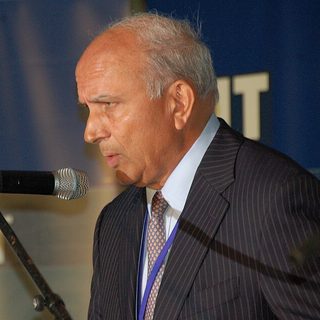
Founder and chairman of Fairfax Financial Holdings — the Indian-Canadian investor often called "Canada's Warren Buffett".
Life story
V. Prem Watsa was born in Hyderabad, India, on August 5, 1950. He attended Hyderabad Public School and earned a chemical engineering degree from the Indian Institute of Technology Madras. Little is publicly known about his parents.
He moved to London, Ontario, for an MBA at the University of Western Ontario's Ivey Business School. He reportedly left India with $8 and sold furnaces and air conditioners to pay his way through school.
How they got started
Watsa began his career at the insurer Confederation Life. In 1984 he co-founded Hamblin Watsa Investment Counsel with his former boss Tony Hamblin, and in 1985 took control of struggling trucking insurer Markel Financial, renaming it Fairfax Financial Holdings.
Over the following decades Fairfax bought many insurers, including Crum & Forster (1998, $565 million) and Allied World (2017, $4.9 billion). Watsa long kept out of the public eye, only starting investor conference calls in 2001. In 2015 he launched Fairfax India with about $1 billion for long-term investments in India.
Investment style
Like Berkshire Hathaway, Fairfax is an insurance group whose premium float is invested along value-investing lines. Alongside buying cheap stocks, Watsa is known for taking large hedges against macro risks such as market crashes or crises.
The group is decentralised: around 26 insurers operate independently while investments are managed centrally. Watsa's salary has stayed at $600,000 for decades, and the company gives 2% of pre-tax profits to charity.
Best decisions
Compounding since 1985
Since 1985 Fairfax's book value per share has compounded at about 18.7% a year and its share price (with dividends) at about 19.2% — from CAD 3.25 in 1985 to over CAD 2,000 by the end of 2024.
Anticipating crises
Watsa profited from Japan's 1989–1990 market collapse through Nikkei put options, and from the 2000–2002 tech bust through puts on the S&P 500 and a basket of technology stocks.
The 2007–2008 credit crisis
By September 2007 Fairfax had built a credit default swap (CDS) book with about $18.5 billion notional, targeting bond insurers and mortgage lenders. The bet paid off handsomely during the crisis.
Biggest mistakes
Equity hedges (2016)
Watsa kept defensive index hedges on the equity portfolio to protect against a market crash that did not come. In late 2016 he removed all the defensive hedges; that year Fairfax booked about $1.2 billion of net investment losses and a net loss of about $512 million.
BlackBerry
In 2013 Fairfax offered to buy BlackBerry for $4.7 billion, then dropped the deal and instead led a $1 billion cash injection. Watsa had sat on the board since 2012, but the full takeover never happened.
Today
In 2026 Watsa is 76 and remains chairman and CEO of Fairfax. According to Wikipedia, his son Ben Watsa is expected to succeed him as chairman and president Peter Clarke as CEO. For fiscal 2025 Fairfax reported about $33.6 billion in revenue and $4.8 billion in net income.
He is a Member of the Order of Canada (2015), received India's Padma Shri (2020), and was inducted into the Canadian Business Hall of Fame in 2024.
What to learn from following the portfolio
- Fairfax's 13F shows only the group's US-listed stocks — its Canadian, Indian and other foreign investments, bonds and hedges are not visible here.
- Watsa often buys overlooked, cheap and sometimes troubled companies — such positions require long patience.
- The 13F lags 45 days; Watsa explains his macro views in detail in his annual shareholder letter, which is worth reading alongside the portfolio.
- Halal lens: Fairfax itself is an insurance group, and its portfolio often includes banks, insurers and financial companies — usually not halal; industrial and consumer names may more often be. Check each position's halal status in the Portfolio tab.
An introduction based on public sources — not investment advice. Spotted an error? Let us know.