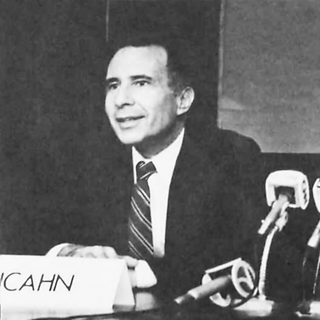
Founder of Icahn Enterprises — the famous "corporate raider" of the 1980s and Wall Street's most seasoned activist investor.
Life story
Carl Icahn was born in 1936 in Brooklyn, New York, to a Jewish family and grew up in Far Rockaway, Queens. His father, Michael, worked as a cantor and substitute teacher; his mother, Bella, was a schoolteacher.
He graduated from Princeton University in 1957 with a degree in philosophy. He then attended New York University School of Medicine but dropped out after two years and joined the Army Reserve.
How they got started
Icahn entered finance in 1961 as a stockbroker at Dreyfus, then moved into options trading. In 1968 he bought a seat on the New York Stock Exchange with $150,000 of his own and $400,000 from his uncle, founding Icahn & Co., which focused on risk arbitrage and options.
In the 1970s and 1980s Icahn became known as a corporate raider, taking large stakes in undervalued companies and forcing restructurings or sales. He gained control of Tappan in 1978 and took over Trans World Airlines (TWA) in a hostile deal in 1985–1988. He sold off TWA's assets, profiting about $469 million while leaving the airline with $540 million of debt — critics called it asset stripping. He also took major positions in Texaco, RJR Nabisco and U.S. Steel.
His main vehicle later became the publicly traded holding company Icahn Enterprises (Sunny Isles Beach, Florida; Icahn owns about 86%). Since 2011 he no longer manages outside money, having returned investors' capital to invest only his own and the holding company's.
Investment style
Icahn is the classic activist. He buys a large stake in a company he considers undervalued, then demands shareholder-friendly change: break-ups, asset sales, buybacks, board changes. He does not shy away from proxy fights or litigation.
His portfolio is typically concentrated in a few large positions and tilted toward "old economy" sectors such as energy (CVR Energy), industrials, automotive services and real estate.
Best decisions
Netflix (2012–2013)
Icahn built a large Netflix stake when the shares were depressed. In 2013 he sold half of it for a profit of more than $800 million.
Apple (2013–2016)
He opened a large Apple position in October 2013 and pushed for bigger buybacks, adding about $0.5 billion more in January 2014. He exited entirely in April 2016, citing concerns about Apple's relationship with China.
eBay and the PayPal spin-off
Icahn was among the activists who pushed eBay to separate its PayPal payments business — PayPal later listed as an independent company.
Biggest mistakes
Hertz (2014–2020)
A big bet on the car-rental company ended badly during the pandemic: in May 2020 Icahn sold his 39% stake at 72 cents a share, losing almost $2 billion.
Hindenburg report (2023)
In May 2023 short seller Hindenburg Research alleged that Icahn Enterprises was overvalued and its dividend unsustainable; the units fell about 20% in a day. The company later halved its dividend, and in August 2024 the SEC fined it $1.5 million and Icahn $500,000 over disclosure failures about pledged shares.
Talisman Energy (2014)
His investment in oil and gas producer Talisman turned into a loss as the stock fell about 71%; he sold two months later.
Today
In 2026 Icahn is 90 and still active: Icahn Enterprises remains publicly traded, and large controlling stakes such as CVR Energy remain in place. His son Brett Icahn is also involved in the investment business.
Icahn Capital Management's filings mainly show shares held by Icahn Enterprises and its affiliates — many of them companies he has controlled for years.
What to learn from following the portfolio
- When Icahn takes a large new stake, it often signals the start of an activist campaign — subsequent news (board seats, restructuring) can move the stock strongly.
- Many of his positions are long-held controlling stakes (such as CVR Energy) — they reflect the structure of the Icahn empire, not a "buy signal" for ordinary investors.
- 13F lags by 45 days and shows only long positions; Icahn's market hedges and shorts (which have caused large losses in his history) are not visible here.
- Halal lens: his usual sectors — energy, refining, automotive services, real estate — often involve highly leveraged companies that may fail halal screens. Check each position's halal status on the Portfolio tab.
An introduction based on public sources — not investment advice. Spotted an error? Let us know.